Three days in Manila

At long last, our post on Manila…

As the time to return to Australia winds down, back in October 2025, we both realise we are “full”. The relaxing time we had at the Wyndham resort in Thailand reminded us that our travel limit, which we first discovered in Africa back in 1982/3, is six months, after that we just need a little “home” time before setting off again. We still have one more short stop to make before heading back to Brisbane: Manila in the Philippines.

Why on earth you may ask would we go to Manila from Bangkok to get back to Brisbane? Well, all the flights over the last six months were all done using Frequent Flyer miles, judiciously accumulated on Qantas and Virgin Australia over the last few years. When searching reward flights 12 months ago to Brisbane from Bangkok, I was offered Jetstar economy overnight via Melbourne, then back to Brisbane. Not the most appealing option. However a little more research got us two Business class seats from Manila via Sydney. We have never been to the Philippines before so while we only have a couple of days there, it will be a new experience for us.

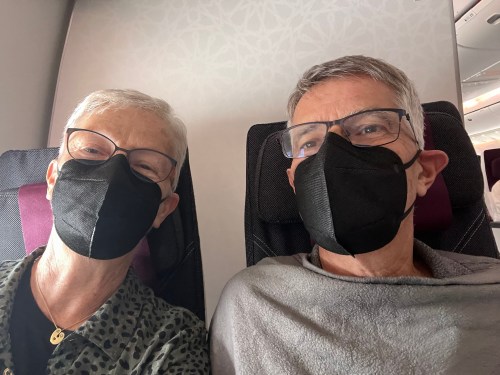
Apart from the rude 3:45am start, our journey involves two three hour flights and a pleasant two hour layover in a Cathay Pacific lounge in Hong Kong. Our four suitcases, plus our carry on luggage, motorcycle helmet and now a large umbrella we seem to have acquired make travel a little more challenging. An interesting aside was that boarding in Hong Kong was done by face recognition only, no boarding passes or passports needed. A first for us.

In Manila, we organise a “Grab” taxi, which seems to be the recommended way to travel there. “Grab” is an Uber like service that we had used in Thailand and the same account works in the Philippines. Great to not have to install another new app while travelling. I understand that “Grab” works over most of SE Asia.

As a last hurrah on this trip, we have used all our Hilton Honors points to book the last three nights at the Conrad Hotel located on the bay near the “Mall of Asia”, one of the largest shopping centres in Asia/World. While the airport is close to our destination, traffic is slow and we learn that traffic jams are normal. Manila has the highest population density in the world which goes to explain the traffic woes. 20km per hour seems to be the fastest speed in the city.

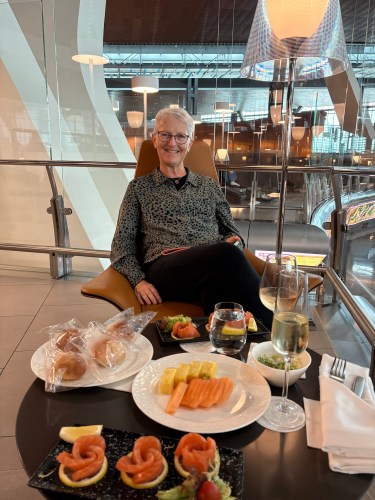
After security checks on our taxi on arrival at the hotel with mirrors and sniffer dogs, bags are whisked to our room and then we retire to the oasis of the Conrad Executive lounge, one of the perks of Hilton Honors Diamond membership, to indulge in food and drink. The service is amazing and as a Coeliac, special food is prepared by the chef, who assures me that she will ensure her colleagues will prepare something for me each night. Excellent service. Thank you. Our stay at the Conrad was made even more enjoyable meeting a lovely family from Okinawa, catching up with them over breakfast or dinner. We hope our paths cross again one day somewhere in the world.

A very late start the next day sees our exploration of Manila extend as only far as the SM Mall of Asia. So much for intrepid explorers, but this shopping mall is one of the 10 largest in the world with over 600 shops, 200 eating places, a planetarium and 16,000 seat arena, so we were exploring, just in air conditioning. Not a world heritage site yet but as I once mused about the Sturgis motorcycle event back in 2015, why not in the future?

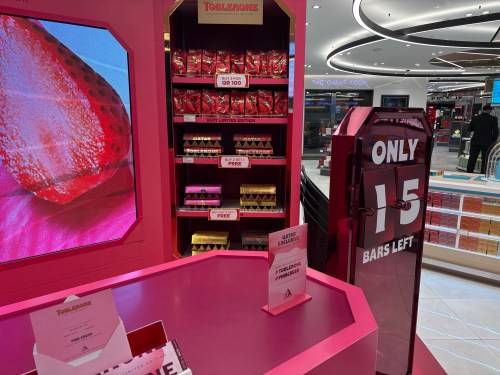
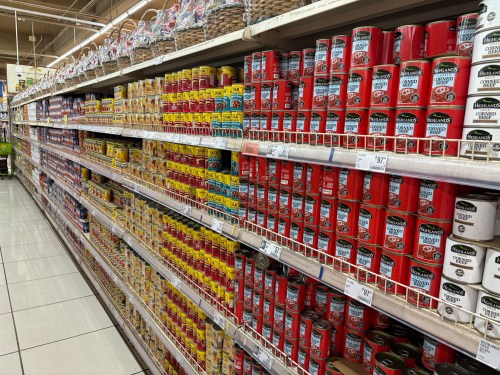
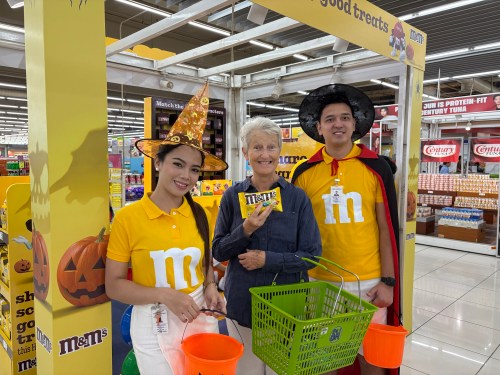
We certainly got our 10,000 steps in as we wandered through the levels of the mall. Our destination amongst all the luxury was the supermarket. I am always interested in what a country enjoys and this can be identified by the isle that has just one product type. In Kazakstan, it was tomato sauce and here it seems to be corned beef, with fish heads and mango, although we had to buy some peanut M&M’s which are Anne’s favourites.

Anyone for corned beef?
A store within a store, please fill the bucket

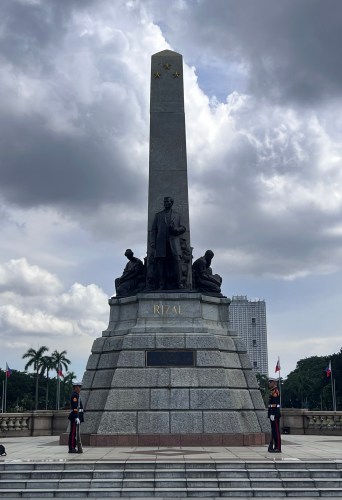
Spending time in the SM Central Business District can give only one impression of the city, we need to spread our wings. We start by visiting Rizal Park, named after José Rizal, a Filipino nationalist who was executed by the Spanish Colonial government, where the park now stands, in December 1896 during the Philippine Revolution which resulted in the Philippines declaring independence from Spain. However, the Treaty of Paris in 1898, which ended the Spanish-American war saw Spain sell the Philippines to the United States, ended the short lived Philippines independence, but that is another story.

José Rizal monument – now guarded continuously by the Philippine Marine Corps’ Marine Security
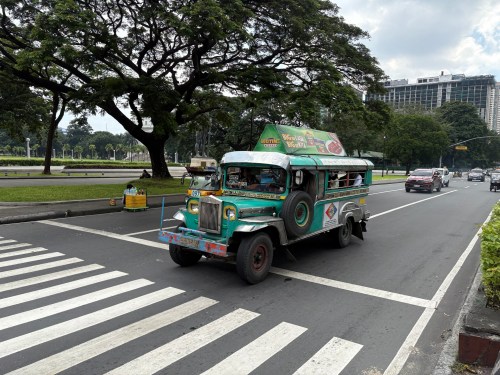
A Jeepney, originally based on WWII Jeeps a Philippine cultural icon
Casa Manila museum – depicting colonial lifestyle suring Spanish colonisation
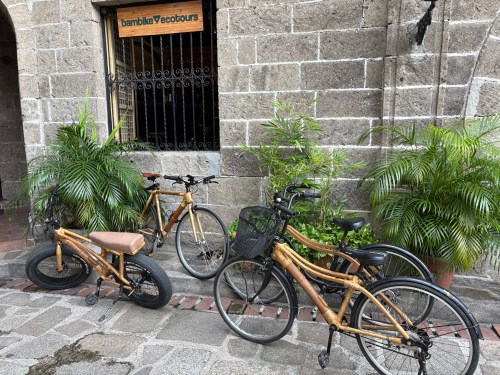
Novel bamboo framed bicycles for hire

We have little time to visit Intramuros, the old Spanish walled citadel, so a closer exploration will have to wait until tomorrow as we are heading somewhat unexpectedly to a Catholic church in the north of Manila.

Anne’s nephew Matthew, who is a Dominican Priest, spent a year working in the Philippines many years ago during his training. I recalled seeing photos at the time and somehow assumed he was located out in the countryside. This was an erroneous assumption on my part as the Church was in fact in Manila. Matthew had put us in touch with some of those people he had worked with previously so we just had to visit them.

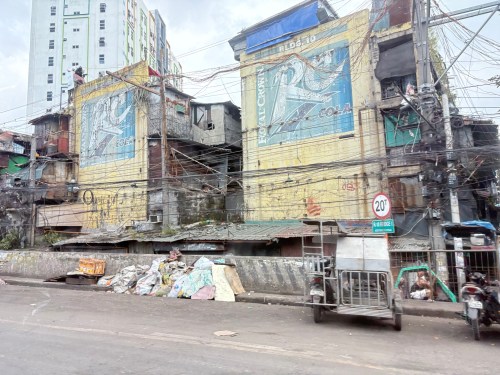
Our Grab ride from Intramuros to Navotas City took us out of the shiny high rise district into a part of Manila where the reality of accommodation is very different from where we are staying in the SM Central Business District.

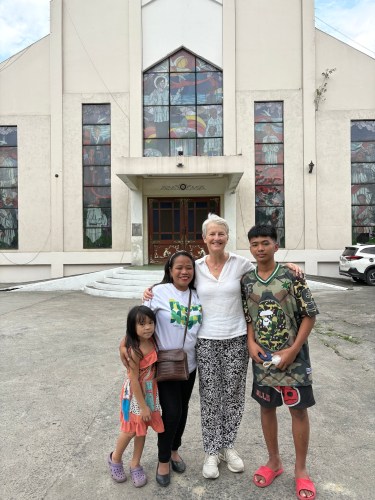
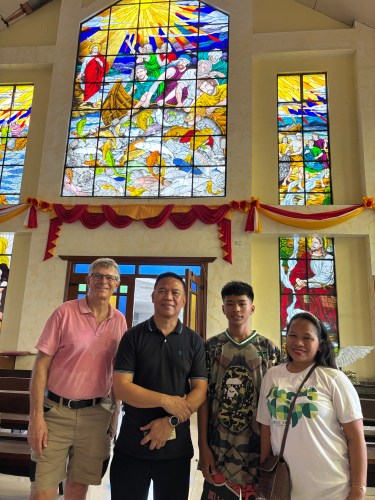
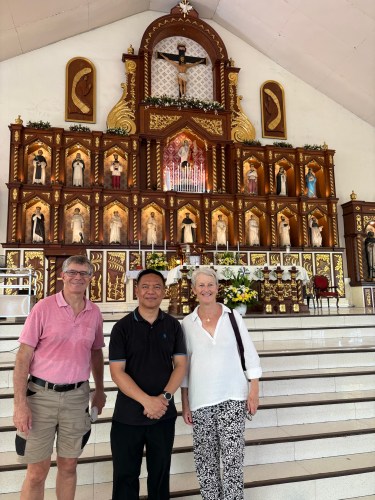
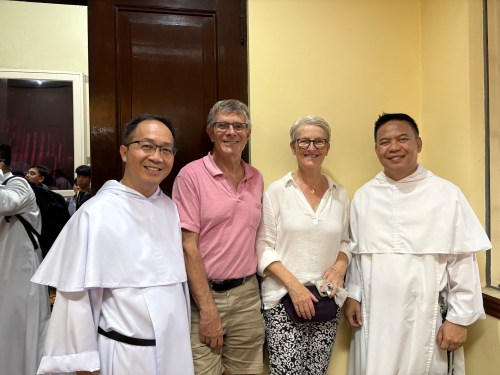
We arrive at the church of “San Lorenzo Ruiz and Companion Martyrs Parish Church” and are given a warm welcome by Delilah and our nephew’s godson JM. We meet the Rector and Parish Priest Rev Fr. Allan V. Lopez, also a Dominican, who had worked with Matthew previously and spends time to show us around the church. The parish was only established in 1982 and the current church building more recent than that with major renovations done following a flooding. It was interesting to see the local features such as the Altar of Saints and some of the, unique to this Church, adornments built into the ceiling that reflected the local culture.

Our nephew’s godson JM and his aunt Delilah and sister
Father Allan, JM and Delilah inside the renovated church our nephew Matthew spent a year preparing for his priesthood
Father Allan showed us around the church he rebuilt after the floods

We had only expected to spend a short time here, but a lunch invitation is extended to us and we are treated to an excellent meal, meeting others who also work at the church. A young French couple, Laure and Martin, are spending a year as missionaries teaching in the parish. While talking with them, an interesting comment was made, while discussing poverty, that, if I understood correctly, no one here in Manila suffered “poverty of loneliness”. An interesting concept I had never considered, that would certainly not apply in our western societies. This made me aware that poverty is not just about food and material possessions.

We had planned to leave straight after lunch but then another offer was made. Today just happened to be one of the biggest events annually on the Dominican Calendar in Manila starting at 4pm – would we like to attend?

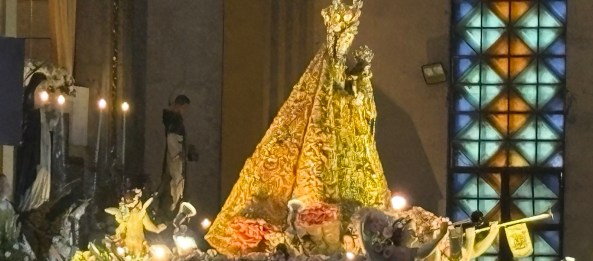
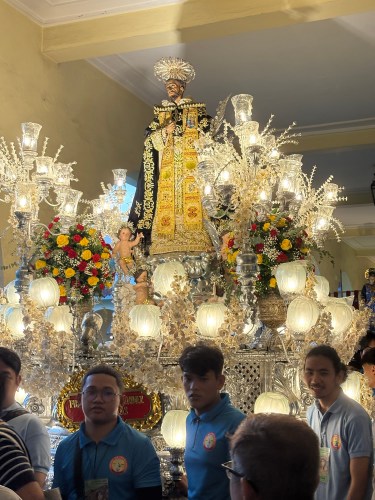
The feast of our “Lady of la Naval” in Quezon City starts at the Santa Domingo Church. The statute that leads the event is formally known as the “National Shrine of Our Lady of the Holy Rosary of La Naval de Manila”, I think I understand why the shortened the name.

The event dating from 1646 celebrates the defeat, in a series of battles, of the Dutch Fleet by the Spanish-Filipino fleet. The Victory is attributed to the intercession of the Virgin Mary on their behalf and the sailors promised to walk barefoot to the shrine if they won.

As we get closer to the Santa Domingo Church, which is also the Dominican Seminary, traffic becomes more congested as both foot and vehicular traffic making their way to the festival intensifies. We continue to sail through the traffic police presence, I am sure the sign on the dashboard, reminiscent of the one used by doctors, “PRIEST ON CALL” aids our progress. We swing through the seminary gates and into a tree covered parking area.

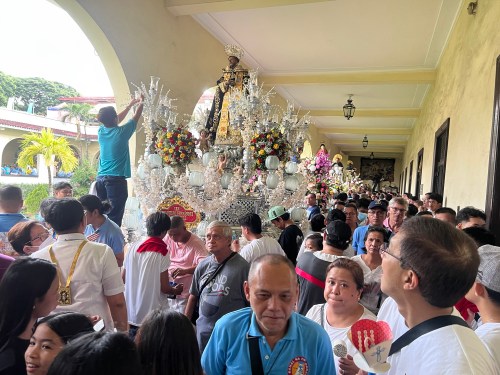
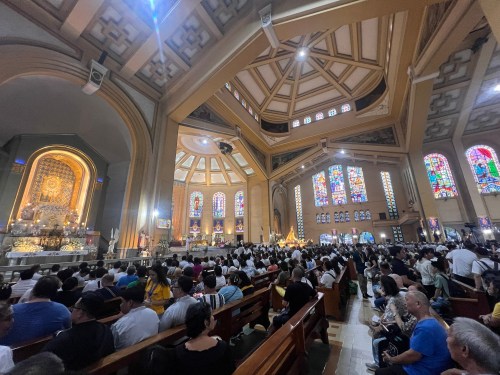
As we follow Fr. Allan through the cloisters, past the elaborate floats, each holding a sculpture of a Dominican Saint, and into the seminary, one can feel the mounting anticipation as the time of commencement approaches for the thousands faithful gathered both inside and outside the church.

Preparing the floats for Our Lady of La Naval procession

As we wait, we meet an number of Fr. Allan’s colleagues including some of those who know Matthew during his time in the Phillipines. We have a privileged position as we wait with the Dominican clergy for the start. We see enough inside then join those outside to see the start of the procession of the Lady of la Naval and the 26 saints through the streets.

Fr. Patrick and Fr Allan
Inside the Santa Domingo Church
Part of Our lady of La Naval procession

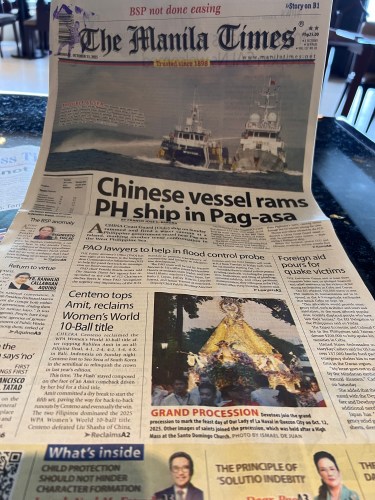
What a wonderful experience, thank you Fr. Allan. The event made front page news on all the local newspapers the next day.

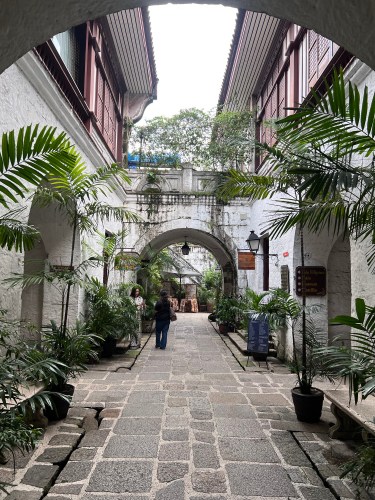
Our final day takes us back to Intramuros and we spend the morning wandering around the old city. The lack of traffic makes for a peaceful stroll for us as we explore what was the centre of the Spanish colony for hundreds of years.

Casa Manila museum – depicting colonial lifestyle during Spanish colonisation

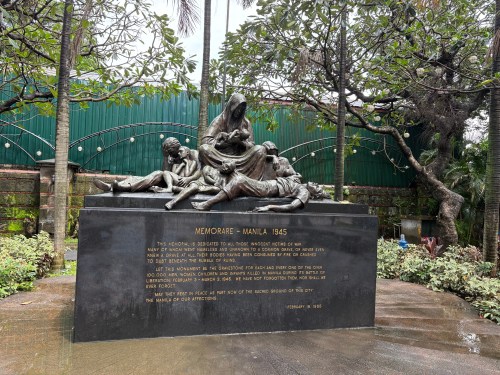
Amongst the wonderful buildings and churches, we find a memorial to those, mostly civilians, who lost their lives during the Battle of Manila in February 1945. The horrific manner of many of the deaths was sobering but sadly in many parts of the world similar tragedies continue to unfold today. When will we learn?

The memorial to civilians killed in the battle for Manila
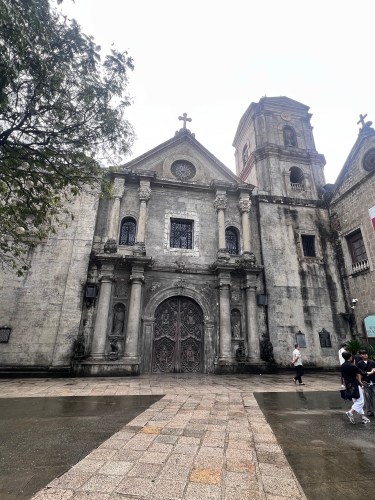
San Agustin church, Manila – oldest stone church in the Philippines and UNESCO site – the only building to survive WWII bombing in Intramuros.
San Augustin Church, Manila

We have had an unexpected and interesting stay in Manila. We have learned more about the people and culture than we thought we would staying in a up market hotel away from the real heart of the city. Thanks to all those who made the experience possible.

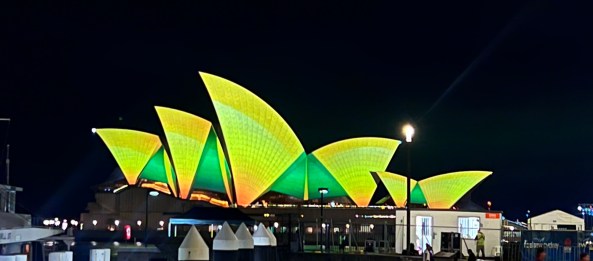
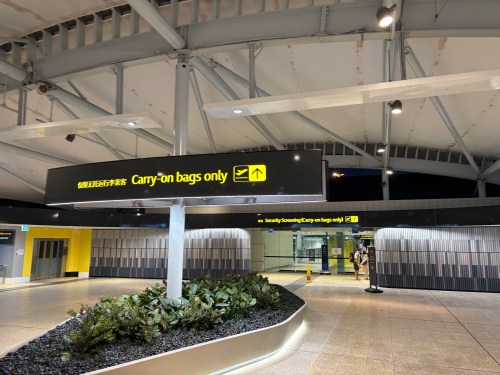
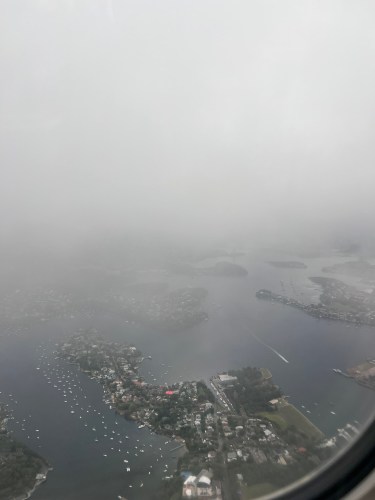
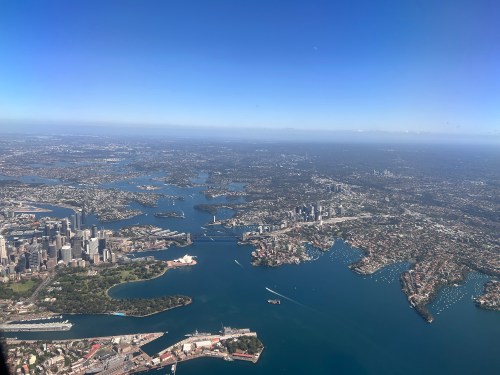
Our flight back to Sydney is uneventful and so much better at the pointy end of the plane. The somewhat chaotic arrival due to limited numbers of those wonderful immigration machines that you need to get a card from is mollified by business class lines at the Domestic transfer that allow us to sweep by the masses and get to the business lounge in the domestic terminal effortlessly. Sydney disappears under the wing and we are headed back to Brisbane. Our volume of luggage manages not to overfill our friend Glenn’s car and we are soon back in Manly. Six months away, it will be good to stay put and recharge our batteries. The last few months away had an even greater toll on us than we realised hence this very very late post. We only have just over three months (just one more month by the time of posting) before we head back to the UK, but that is a story for 2026.

Sydney – one last flight and we’re home
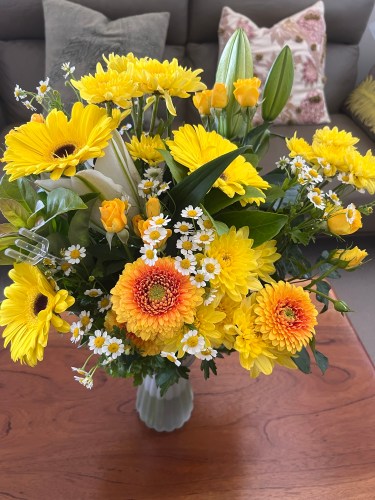
Beautiful welcome home flowers from Anne’s sister Diane as we unloaded our luggage from Glenn’s car

Wishing all our faithful followers and your families a peaceful, joyous and healthy 2026.

– Anthony
A week exploring the Thailand east coast

We left Chiang Mai knowing we will be back. But having spent quite some time now looking for somewhere quieter than where we are now, but still with water views and good walking, how come Chiang Mai which is a long way from the ocean has such a strong pull?  We have seen our suburb of Manly transform from a quiet village feel 28 years ago to a place so overrun with day trippers every weekend that we avoid walking along the esplanade on a weekend.  But we have never tired of the view we have and that is why finding a replacement has been tricky. We feel we need a view, preferably a water view and walking distance from good walking, and with a community sense. Chiang Mai is far from an obvious choice, or even understandable choice… apart from the good community feel.

We are looking forward to checking out a number of quieter places by the ocean. A quick flight from Chiang Mai to Phuket where we can pick up a one way car hire to drop off in Bangkok before we leave Thailand will enable us to visit a number of places along the way. With so much beautiful coastline, we had received far too many suggestions on where to look. Reluctantly we have filtered it down to coastal areas on the gulf of Thailand south of Khanom, south of Saphli, around Pak Nam Pran and east of Rayon. Wonderful tropical islands with minimal inhabitants and limited access to good medical facilities have been excluded.

When we were in southern Thailand in December 2014 on Streak and Storm, we did not visit Phuket due to its size and development back then, what is it like now? Anne fairly quickly gets the hang of driving here while I handle navigation. Taking a backroads route to our hotel at Choeng Thale gives us glimpses of many existing property developments interspersed with local businesses and native bush. There are signs and banners for new luxury townhouse developments being spruiked in English, Chinese and Russian, sometimes only Russian.

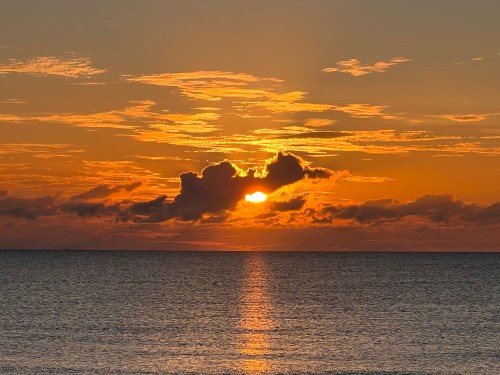
Sunset on Phuket – not for us

Our impression is that it is too busy and built up for us and we head north the next morning.

After leaving Phuket Island we follow Highway 4 North East driving on the same route that we rode almost 11 years ago, although I cannot recall any details. We are heading for Khanom. While there we also plan to catch up with Philippe, a friend and fellow motorcyclist from France who we met back in 2016 at the South African Horizons Unlimited event who is now living on the nearby Island of Ko Pha-ngan. En-route we stop for lunch and meet Ford. He is running his parents restaurant, working as an architect remotely and studying for a Masters in Town Planning, very impressive. You never know who you will meet on the road.

Ford shared his dreams of becoming a town planning architect
Ford’s father built this spirit house – the local carpet snake feeds on the offerings everyday

You would expect a place call “Le Petit St.Tropez” to be run by a French person but no it was Dutch. Being between seasons, we were the only occupants so a very quiet night was had. It was great to catch up with Philippe the next day for lunch. While it had been years since we last met, the conversation flowed as if we had only met recently. A great time was had. It would have been nice to have a couple more days but onward we must go.

Little Saint-Tropez beach
Great catch up with Philippe

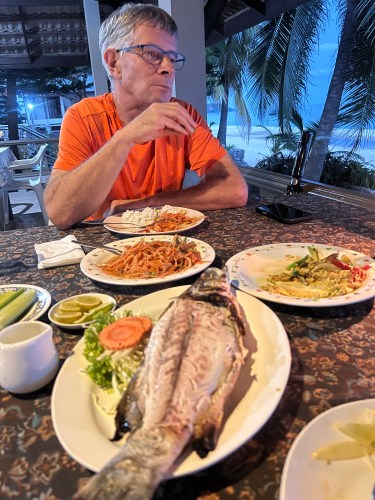
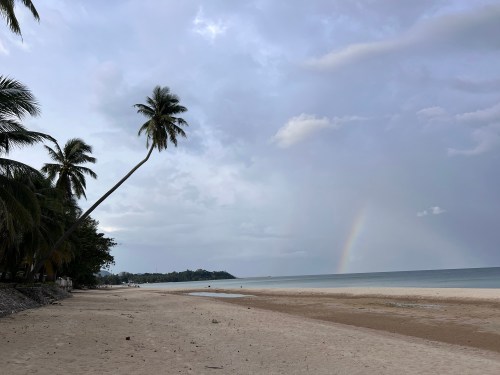
We head to Thung Wua Laen Beach which one of our friends’ friend in Chiang Mai had recommended. Anne selects Clean Wave resort – what a find it turns out to be. We have a little bungalow across the road from the “resort’s” restaurant building. We soon meet the only non-thai there, chat with him to find out he is married to the resort’s owner. He is Swedish and has been working in Asia for 30 years and his wife used to be a hospital administrator – both a great source of information on the hospital scene and living in Thailand as an “expat”. This beach only has a handful of non-Thais, has a great feel, has fabulous coffee and seafood and is just a few kms south of the next little piece of paradise on the other side of Saphli.

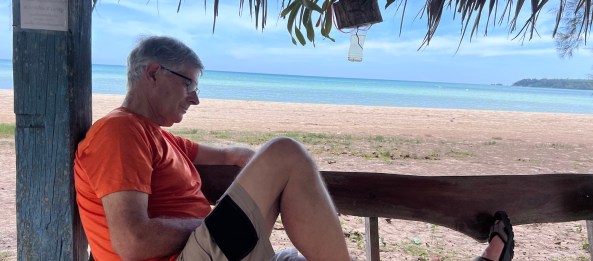
Our breakfast view – Thung Wua Laen Beach south of Saphli
Another delicious meal on the beach
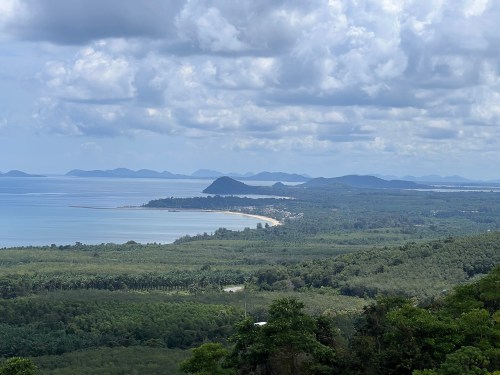
View towards Saphli and just beyond, where we are staying at Thung Wua Laen beach
Think you have got a magpie problem
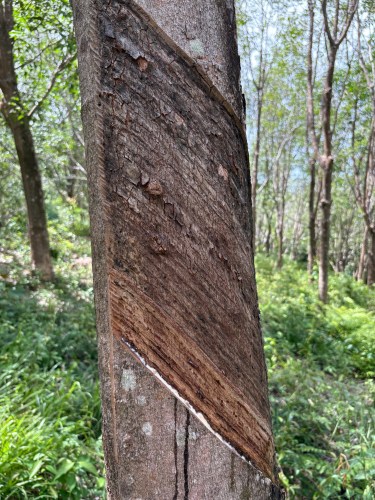
Rubber tree latex is collected in cups
Diagonal incision in the bark allows the milky latex to flow out
Waiting for lunch
Lunch on another quiet beach, Bo Mao beach just north of Saphli
Wonderful family staff at Thale Thong Seafood restaurant, Bo Mao beach – 2 mothers and 2 daughters
Thung Wua Laen Beach
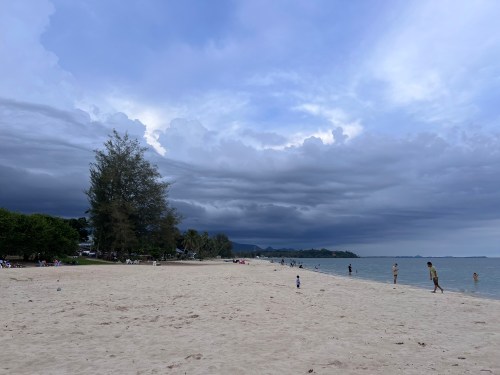
The storm is building – Thung Wua Laen beach

We both book ourselves another massage before continuing our route north. They are so cheap here! AU$10 to $20 an hour. In Chiang Mai, we had a 2 hour massage for $20.

As the time of our return winds down, we both realise we are “full”. We end up south of Hua Hin which we have not planned to visit again following a visit there some years back being too busy and touristy. Time to make the most of a lovely swimming pool, a local seafood restaurant where we meet a long term expat and get more pieces to add to our puzzle.

Khao Tapiak
Khao Tapiak

Our last stop is Rayon to the east of Bangkok. We navigate across the toll roads around the city and arrive at our destination having driven past factories and other industrial facilities for a couple of hours. Why was this region suggested to us?

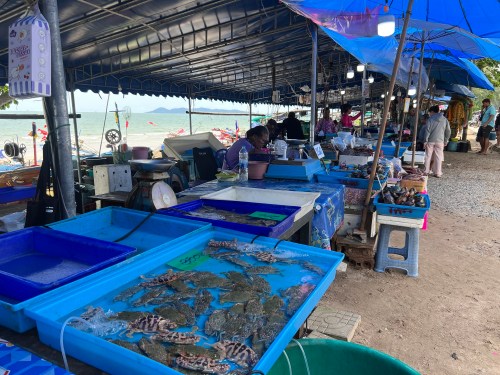
Next morning we head further east for 20km, turn off towards the sea and enter a different world. Beach to one side, local shops, a fresh fish market with the fishing boats drawn up behind each stall. This little strip at Rayong beach is completely different but close enough to hospital and other facilities we may need. There is an expat community which we meet at the Stay Cafe on Mae Ram Phueng Beach.

Hat Suan Son Seafood market – east of Rayong – select your seafood and take it to one of the local restaurants nearby for them to cook
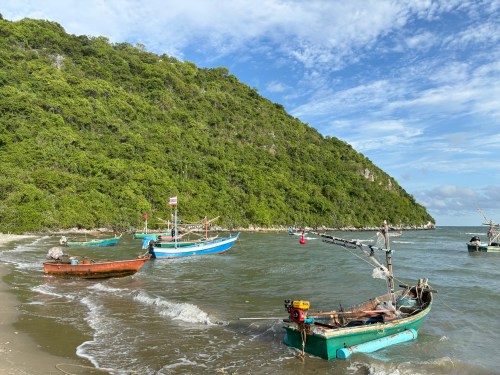
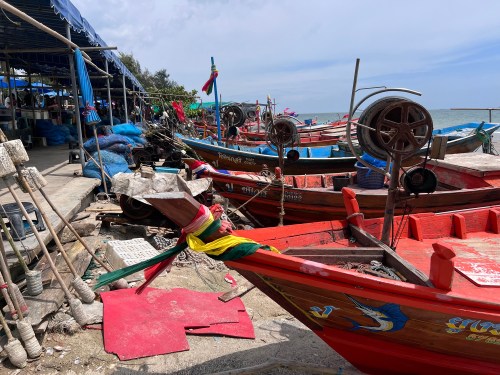
Hat Suan Son fishing boats – Rayong
Flower garlands often adorn trees to show respect to them as sacred
Every building has 2 miniature shrines – offerings are made to keep the spirits happy and benevolent
Archways depicting the king are found along major roads and at most village entrances/exits

This last couple of weeks in Thailand have not only increased our knowledge of the country as a potential retirement destination but just as importantly helped us get a better understanding of what we are looking for and how we might achieve that. Our thanks to all who gave of their time to enlighten us and while we have no timeframe the possibility of moving to Thailand one day and becoming part of a community there is a distinct possibility.

It has been a very enlightening visit and has given us plenty of food for thought. Time to head home now. Final stopover will be Manila for a couple of days.

– Anne & Anthony

A week in Chiang Mai

A week has passed since we touched down in Bangkok, swapping the early chill of autumn in Finland for the sauna-like humidity and heat of Thailand. After a day and night of recovery in Bangkok, we headed to Chiang Mai to stay with our friends Micheal and Nuch.

We have always enjoyed Thailand, ever since our first visit here way back in 1986. The people, the culture, the scenery, the food have always attracted us to spend time here. As the years have rolled on, even we will have to think about retirement one day and the environment we wish live in. Reading of some of the changes the Thai Government has made to ease foreigners wishing to retire here, plus the positive experience we had back in December 2019 during our last visit, makes it worthwhile to try to obtain a understanding of living in Thailand.

So this blog entry will not feature the major temples and palaces, rivers, beaches and mountains but just a few thoughts on Thailand as a possible retirement destination. Ok not all work, I will have to try a few beaches, pools, massages and sunset drinks during our visit.

New security guards at Suvarnabhumi Airport?
Smart idea at Suvarnabhumi Airport set apart from security.
It’s still the rainy season in Chiang Mai

Michael and Nuch are so welcoming: we have our own guest cottage a short walk from their house which is situated near Nong Yaeng, north east of Chiang Mai. We had indicated that we wanted to get a feel for the area and they obliged by taking us to restaurants, coffee shops, markets, supermarkets and meeting some of their friends.

Nuch and Michael at Mae Kuang Udom Thara dam
Judith’s amazing gluten free chocolate and raspberry cake at her café “Simple Pleasures Café”
Live music at Simple Pleasures Cafe

We even spend a morning visiting a local retirement facility. No, we are not moving in yet, but wanted to understand what does exist here as a long term option. The facility was acquired from local owners by a european group which will offer places to people from Europe. If one did not know better, you would think you were at a resort.

We felt a real sense of community amongst expats living in this area. This is something we consider important in where we might one day end up living.

To obtain a different perspective, we then relocated closer to the city. Staying at the Balcony hotel we had hoped to catch up with a couple who had relocated here recently but our timing coincided with their travels back to Australia but met others who had made the move to Chiang Mai and were now living at the Balcony. It also appears to be the base for other digital travellers who have an interest in motorcycling. Chiang Mai offers an amazing variety of riding, both on and off road including the famous 700km / 430 ml. long Mae Hong Song loop. We did not have any time to ride here on this trip, though we may have covered a small section back in 2014 en route to Laos. I will have to look at my GPS route on return to Australia.

The Balcony hotel
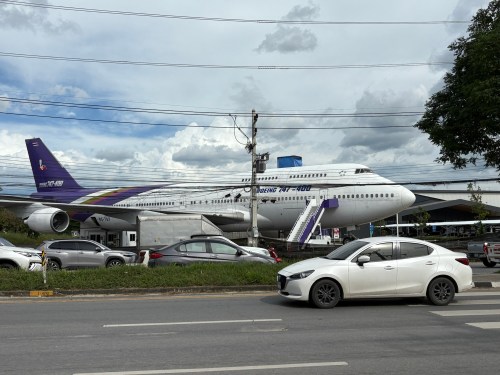
Not quite sure how this got here? Great piloting?

We are lucky enough to spend a little time with Grace, who runs HiVolt. Off road riding is her speciality as well as exporting specialist parts for off road motorcycles. Interesting that here people ride small cc motorcycles, around 300cc when we are used to much larger engine displacements.

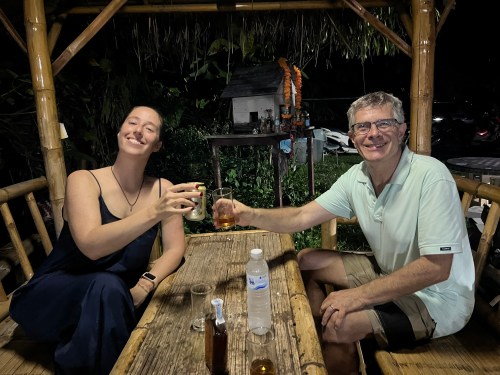
Evening drink with Grace
We bought the drink from this shop and drank it across the road

The only “sightseeing” we did in Chiang Mai was to visit Changthong Heritage Park – a 12 acre private botanical museum of ancient trees, beautifully curated by Mr Khun Chang over almost 20 years.  It was wonderfully peaceful to meander through this park – and admire the vast selection of ancient trees, the moss paths and stunning waterfalls.

Changthong Heritage Park
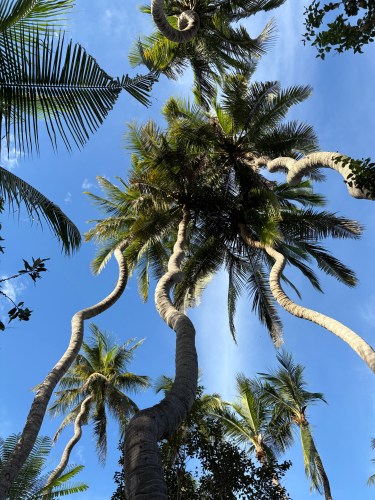
Spiral top coconut trees at Changthong Heritage Park

As our week in Chiang Mai drew to a close, we have to thank everyone who listened to our questions, offered their thoughts and generally gave us a very positive view of Chiang Mai and the people who live here.

Thanks Micheal and Nuch for a fantastic time in Chiang Mai

Next we head off south of Thailand to see whether a place by the ocean awaits us for a potential long term move.

– Anthony and Anne
Barents to Baltic

Nordkaap, the most northerly point in Europe that one can easily access by road and a magnet for adventure motorcyclists heading to this part of Norway. Sadly we will not be able to join those other intrepid riders’ celebrations on the culmination or start of their journeys as we are in the comfort of four wheels.

Awaking in Honningsvåg, we are again blessed with better weather than forecast. Glimpses of blue sky and no rain as opposed to the grim cloud and rain all day on the app. A leisurely breakfast is interrupted by the blast of an arriving cruise ship horn, masses of tourists with the same destination as us: Nordkapp. Swiftly to the car and out of town heading across Magerøya Island. While appearing barren without a single tree to be seen, the landscape abounds with grasses, lichens and mosses in a carpet of woven greens, browns and reds. Climbing higher, we see Skipsfjorden and Tufjorden, both fjords, long fingers of water that have provided safe havens for ships in time of storms.

Looking west from Nordkaap
Perfectly camouflaged reindeer

Standing near the Nordkapp Globus monument looking out over the calm Barents Sea, our timing could not be better: blue skies and sunshine – our luck continues. The obligatory photos are taken at the monument with the visitors giving each other time to get that memorable photo. Mist then envelops the building behind us and out of the mist, the cruise ship hordes eerily appear. Time to depart.

At the Globus looking over the Barents Sea
Tourists in the mist at Nordkaap.

We return via the small fishing village of Skarsvåg. Here reindeer do wander the streets, a single coffee shop is open and we are the only visitors. The summer season is over and tourist related facilities are closing or have closed. Our hotel’s restaurant had closed for the season the night before we arrived.

“Yes dear” more rein-dear.
Fishing trawler in Skarsvåg

One thing we have noticed, both in the open areas and forests away from the coast, is the absence of bird song – always very quiet. I do not know if it is the time of year or that few birds live this far north.

To leave Magerøya Island, one travels through a seven kilometre long tunnel that descends for three kilometres from each entrance at an angle of 9-10%. I will let you do the math on how deep that is. I am always watching for leaks! A sign warns of “Fog in Tunnel” and they are correct. Quite weird but I am sure there is science to explain that.

“Fog in tunnel”, the sign was correct.

The road follows the shoreline of Norway’s fourth longest fiord, the Porsanger, which stretches for 123 km. / 76 ml. And it takes over an hour driving to leave the fiord and the Barents sea behind. The next sea we see, will be the Baltic, hence the title.

Very smart large bin to avoid littering
Autumnal colours in the far north

Anne has never visited Sweden and is one country behind me as I snuck in Qatar, which Anne had previously visited, on the way to Europe in April. Our route today allowed a crossing into Sweden for a new minutes on Swedish soil, so we are all square again. ( it does not count says Anne).

Anne’s first foray into Sweden.
View of Finland from Sweden

Overnight near the ski resort of Levi where we see last year’s ski slope snow piled up under white covers and will be used to form the foundation for this season’s ski slopes. This helps form a good base for the first snowfall of the season. I had read about this phenomenon but never seen it. Amazing how so much snow can last for the whole summer.

Ski run base all ready for the new season

At dinner as usual we see that many meals in Finland are both Lactose and Gluten Free, usually signified by an “L” & “G” on the description. Great for both of us.

Back to Rovaniemi the next morning where we started journey by road to the North. The night sleeper takes us back to Helsinki, but not quite as comfortably as I had hoped. I am looking forward to a good long massage when we get to Thailand.

We are upstairs on this train.
Our train back to Helsinki courtesy of Santa
Our luxury overnight cabin with snacks and single malt whisky
Our train’s silhouette as the sun goes down.
Skidoo route this way
Helsinki train station – with only the Ukrainian flag flying

An early arrival sees us at our Hilton Hotel, thanks to Diamond status, we are able check into our room by 7:30am! Membership of Hilton Honors does pay dividends.

We spend the morning as it rained sorting the contents of the four suitcases, three of which handily stayed at the hotel during our travels. A last trip in the afternoon to central Helsinki saw us wander amongst the food and produce stalls at the waterfront. One stall-holder kindly spent time explaining the different berries and mushrooms and how to use them in cooking even though we could purchase nothing. A last glimpse at the Baltic sea and we have completed Barents to Baltic.

Roberts Coffee in a converted Art Deco Bank building on Pohjoisesplanadi Helsinki
Art Deco work on Pohjoisesplanadi Helsinki
This fresh grilled fish outdoor stall looked delicious
Colourful street stall on Market Square Helsinki

Our time in Finland has come to an end. We have enjoyed our time immensely, seen and done more than we expected. We would like to return in winter to see the transformation the snow makes, but that will have to wait for another time. From the tranquility of the Finnish countryside, we are heading to the metropolis of Bangkok where the temperature will double and the sounds, smells and tastes of Asia will assail us – should be great.

– Anthony
Sámi country

Well that is a hard act to follow – the northern lights performed as if on command for Anne, with a side showing for me. A real privilege to see such beauty dancing across the skies. But on we must…..

The last day of summer today, then 10 months of winter”. We heard those chilling words from a local as we prepared to head further north into Lapland. We have the freedom and flexibly of a hire car for the next week and dual objectives, firstly to learn more about Sámi, the name of the indigenous people of Lapland, culture then secondly see the northern lights again. The second already achieved even though the weather forecasts seemed to rule this out.

Reindeer!! We see our first reindeer beside the road; so exciting. No place to stop so onward we go, more reindeer ahead and a place to pull over. Lots of photos, however the novelty wears off and we are now experienced reindeer viewers and ignore many sightings unless they are perfectly positioned for photos.
Yes they are watching us too.
Impressive reindeer in the wild.
Just like Kangaroos, no road sense.
Young bucks learning to duel as autumn approaches

Our accommodation outside Inari is a beautiful log cabin at the Wilderness Hotel Inari, right on the water’s edge with stunning views over lake Inari. Our own log fire and sauna are included with enough firewood to keep us warm day and night. A clever combined match and fire-lighter make starting easy. A warm fire and a sauna, what a great combination, luckily the wrong season for rolling in the snow.

Our Inari lakeside cabin
The view from our cabin lounge

The rain has held off again and we walked to Inari, the colours of autumn are all around us, further north we travelled we have found more and more silver birch leaves have turned yellow.

SIIDA is the Sámi Museum and Northern Lapland Nature Centre in Inari which has interesting and informative displays on Lapland, plus outdoors there are number of buildings that have been brought to site. They have also recreated a number animal traps showing both ingenuity and engineering skills.

Inside the SIIDA Museum.
Outdoor Sámi display of traditional houses

A tour of the Sámi Parliament was both informative and interesting to see how an indigenous culture interacts with national government. Similar Sámi parliaments exist in Norway and Sweden. Less is known about interactions within Russia. We learned there are five Sámi sub groups and three Sámi languages, Northern Sámi, Skolt Sámi and Inari Sámi. All three languages can be used in the Finnish Sámi Parliament. The full Parliament meets four times a year and provides advice to and negotiates with the Finnish government of affairs that impact the Sámi people.

Inside Sajos, the Sámi Parliament chamber with relief artwork “Eatnu-Eadni-Eana” (Stream-Mother-Ground) by Outi Piesk
Traditional Sámi handicraft of reindeer antler bones, tin wire and bead embroidery

A series of paintings quite cleverly in some cases indicated the dos and don’ts of tourism as it pertains to Sámi culture.

Sustainable tourism vs careless tourism.

AI and dog sledding. Now here is an interesting combination. When I searched Google for “were dog sleds ever used in Lapland”, AI gives me this:

Google AI overview. “Yes, dogs sleds were historically a crucial form of transportation for hunting and travel in Lapland, and remain a popular cultural activity and tourist attraction today. This centuries-old tradition was a primary way for the Sami people, the indigenous inhabitants of the region, and others to navigate the vast, snowy landscapes of the Arctic”

Sadly this is incorrect: we learned during our tour of the Sámi Parliament in Inari that Sámi used reindeer dogs for herding, but not huskies. Reindeer were used to haul loads. Sled dogs, used by eskimos in North America, are a relatively recent introduction boosted by foreign tourism and not always done to the benefit of locals or the dogs. The proliferation of such tourist organisations and descriptive websites using borrowed traditions likely leads to this not unreasonable conclusion by Google AI. How much other information we are presented with by AI could have evolved by similar means? I will try to follow up with Google on this, supposedly there is a way to do this.

The proliferation of these dogs also has the potential to interfere with the reindeer herders’ livelihood we were told.

After Inari we still had three and a half days of car hire left. Where to go? After pouring over maps, comparing options, further north it is – how far, we are dependant on the weather, and yes rain is forecast again.

Once again, we are lucky with the weather and cross into Norway. We have decided to go all the way to Nordkapp or North Cape as we call it. We make good progress, just an initial challenge is the lack a centreline on many Norwegian main roads, just edging dashes causing a few interesting moments as we adjusted to this with oncoming motorhomes or trucks. As we head northwards the trees gradually give way to open landscape and stunning views.

No centre line, but two lanes wide, just.
Great road to sleep on

Nordkapp awaits for us tomorrow.

– Anthony